One of the first things I learned about Senegal was that an island off the coast of Dakar was the largest exporter of African slaves. What a depressing Google search. At the time I didn't really know what that meant. Why? Seeing it from an American perspective, all there is was how horrible slavery actually was and how it's torn the fabric of society. No matter how hard we try to stitch it up, our history is always there lurking in the background.
So when I finally visited this island, called Goree Island, I was interested this was not how it was perceived in Senegal. The port was decorated with flat screen TVs, showing snap shots of important people's visits: Obama, Clinton, Hollande, Sall, all of them looking contemplative.
We got off the ferry and were welcomed with exuberant drumming, bar signs, and local women trying to entice us to visit their shops. The tone of seriousness, of gravity, that I was expecting did not greet me.
So what did we do? We went shopping. Honestly, my first impression of the island reminded me of my quick trip to ; colorful French colonial buildings, manicured plants yet it still gave the impression of not being cared for, and, most of all, the sellers. Rasta men followed us around playing some sort of marachos, trying to get us to forever remember Goree with a fun, easy instrument. All of us declined, but that didn't stop me from practicing. We did end up visiting the artisinal market, where there was an assortment of bags, clothes, jewelry, and fabrics. Unlike the Caribbean, where I felt so overwhelmed I just shut down and didn't buy anything, this time I was equipped with my Pulaar and two years worth of haggling skills. I also found another Diallo, and she gave me a good deal on some bags (because we're family).
Shopping was followed by a walk around the island. We walked up, past the art vendors and restaurants, and followed by the Rasta men. Goree also used to be a French base, so it was peppered with large guns. All of them had vendors, and some of them were a stone's throw away from some one's home. There were cliffs overlooking the ocean, and you could see the port from the east side of the island. Very picturesque.
During our walk we tried to go to the Maison Des Esclaves (House of Slaves). The eastern shore was filled with these houses, where the slaves would be quartered before being sent to the Americas, and only one is now open for tourism (the others have been converted into homes). This is the place the Obamas had a pensive photo.
It was closed when we tried to go, but we did meet a tour guide. His name was Mamadou Balde, so I immediately had to question his credentials. When I insinuated that he was probably really bad at his job, he discovered I was a Diallo. "Ah a Diallo! A slave! When we are done here I'll take you to the house of slaves were someone can buy you! HAHA."
You would think this would be followed by an uncomfortable silence. It wasn't, because slavery is part of the joking world that I've been involved with for two years. Baldes and Diallos call each other not only bean eaters, lazy, and ugly, but also slaves. Pullars call the Mandes their slaves because they were actually
their slaves just a short while ago, and even the Wolofs even get a jab in every now and then.
Slavery is talked about, but let's remember Senegalese slavery is not the same as the back breaking, dehumanizing slavery that was found in the United States. This does not make it ok,but it may explain why the Senegalese don't have the same feelings about slavery as Westerners, specifically Americans.
So Balde and I joked about enslaving each other on this memorial to the horrors of slavery. I know it sounds bad. Then Balde looked over at us, very gravely, and started giving us a history lesson in jilted English.
"You know, we're all to blame, black and white, Senegalese and American. The Americas wanted the slaves, but we didn't have to give them."
I'd like this to be an uplifting end to a blog, it can't be in the way Americans will want it to be. I doubt that Western slave merchants would have given up the slave trade had there been no African middle man, and I doubt the African merchants knew what they were getting their merchandise into. What struck me was that Balde had the script down pat, but he didn't really know what he was saying. Countries like South Africa, Zimbabwe, the US, they know what racism is. And when I say racism, I don't mean getting "toubab" yelled at you on the street; I mean actual hatred of another human being for no other reason than the color of his skin. But Senegal, they don't get racial hatred; it's just never come up. And maybe that could be a different kind of happy ending.
How many of you who are going to be doctors are willing to spend your days in Ghana? Technicians or engineers, how any of you are willing to work in the Foreign Service and spend your lives traveling around the world? On your willingness to do that, not merely to serve one year or two years in the service, but on your willingness to contribute part of your life o this country, I think will depend the answer whether a free society can complete. I think it can! And I think Americans are willing to contribute. But the effort must be far greater than we have ever made in the past.
-John F. Kennedy
Wednesday, February 4, 2015
Thursday, December 11, 2014
Thanksgiving!
I love Peace Corps life, but the worst thing is not being able to see my family. This is especially true during the holidays. Thanksgiving, my favorite holiday in America (no fluff Christmas, plus football! what's better than that?), was celebrated with a Senegalese twist this year with my new family in Kolda. We even got a turkey! (Please try to understand how amazing this is.)
Yours truly even worked in the kitchen for a while.
Oh yeah, and it might have been Hobbit themed.
Yours truly even worked in the kitchen for a while.
Oh yeah, and it might have been Hobbit themed.
![]() |
| Getting ready the kill Boromir the Turkey. |
![]() |
| Group Thanks. |
![]() |
| Kolda Wall of Thanks! |
![]() |
| Just grabbing some organs for the gravy |
![]() |
| FEAST. |
![]() |
| Mulled wine... yum |
Malaria Tourney
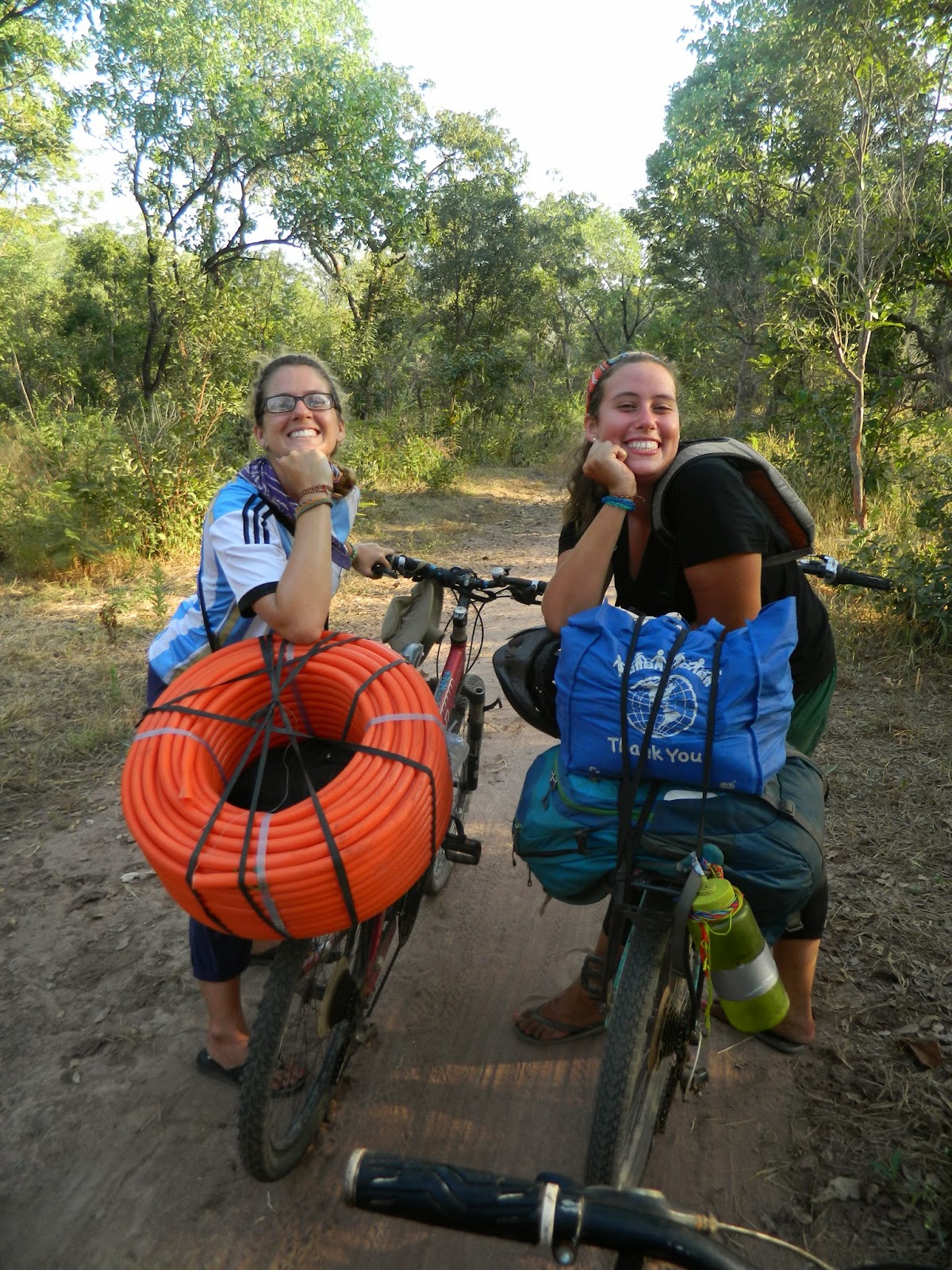
So what Courtney and I did was wrote the grant, chatted with local health officials to keep them informed, buy the supplies, load up our bikes, and head out to the open road to personally stomp out malaria. We opened up the project to the entire region of Kolda and got 18 bites. That's 18 sites, covering about 200 km on our bikes (my calves look really good right now), with baggage strapped to our bike racks.
| Look Mom! A transformed net! |
Theater sketches had varying success. Everyone who prepared a sketch did a great job, but sometimes the draw could be too much. Too many kids, too much talking, and no one would be able to hear anything, which was the whole point! The theater sketches were part of a larger contest. The top three sketches are going to be recorded and played on the radio in January! Thanks and congratulations to Stephanie McAlexander and Nathan Rehr, who came in first and second. Third was my health post, organized by our matrone, Tako Balde.
With 18 sites ranging in size, proximity to the main road and therefore education, goods, and amenities, we had a wide range of experiences through our month long experience. A generic morning would have us begin the program around 9, pulling water for washing, hanging rope for drying, prepping needles for sewing, and tubes for transforming. At our low we washed two nets in a morning and at our high we washed 65 nets. By "we," of course I don't actually mean "us." I can barely wash my clothes let alone a heavy, rough mosquito net.
So the work was fun, but the play was also fun. First year health volunteer and friendship bracelet maker extraordinaire Lexi Merrick accompanied us for about 10 sites near her, and was therefore a part of the most biking intense part of the trip, and first year health volunteer and my site mate Nathan Rehr was with us for the five sites closest to us. Being an on-point Pullo for that long can be exhausting, so it was good that we could switch on and off who was going to be lead person each day.
It was also really awesome to see so many of my friends, who I know in their America, Peace Corps contexts, as their Pullo alter egos. We got to see where they live, where they travel, who they live with, what they eat, everything. It's amazing how different every site is and how very similar everything actually is.
| Oops. |
| What baggage? |
Scholarship 2014
Oh hello! Just recently remembered that I have a blog, but in my defense I've been very busy! Forgive me, but I'm going to go a little bit out of order and start with my scholarship girls because I love them the most.
So as my Facebook friends will know, I did the Michelle Sylvester Scholarship at my local middle school again this year. The goal of the scholarship is to keep at risk girls in school. "At-risk" includes risk from poverty, risk of early marriage, and risk of pregnancy. It also awards high achieving girls- all of my girls were at the top of their class.
You'll all remember my girls last year (pictured below). I had six of the smartest girls in the school in the program. This year, one went on to high school, one failed her finals but passed her BFEM (the test one needs to pass be allowed to go to high school), two are in 3eme this year (9th grade) and were awarded the scholarship again, and two got married and will not be continuing their education. In an effort not to turn this specific post into a rant about my feeling on teenage marriage, I'll just say I'll write about it later.
This year, though, we added three more girls to the list. Peace Corps (and by "Peace Corps" I of course mean my wonderful donors) paid for their inscription fees (about $10), bought them notebooks and pens, and the American Embassy in Dakar sweetened the deal by giving out free book bags literally full of everything a student is supposed to have and is almost always too poor to buy. This includes more notebooks, pens, pencils, protractor, ruler, mini chalk board, pencil case, and I'm forgetting everything else, but trust me, it's good. I told everyone it was from Obama, and were the mid-term elections in Sanankoro, I would now have total confidence in the Democrats sweeping it.
I had a much better time of it this year for several reasons. 1. I speak Pulaar this year. Last year I had to get the project started my first week at site, which was overwhelming, and I'm pretty sure not everyone understood everything, myself included. 2. I have a relationship with the school this year, and they trust me a lot more. 3. I have a relationship with the girls, and getting the scholarship is actually a really big deal now. 4. I had a much better outfit.
Let just conclude with a congratuatory note to Dienabou and Khady, who received the scholarship two years in a row, Mariama Sow, Fanta Seydi, Dienaba Kande, Mariama Balde, Assette Balde, Salle Mballo, and Asmou Seydi, CEM Sare Koutayel's scholarship girls and Senegal's future presidents, doctors, lawyers, and ministers. Not that I have high expectations or anything.
So as my Facebook friends will know, I did the Michelle Sylvester Scholarship at my local middle school again this year. The goal of the scholarship is to keep at risk girls in school. "At-risk" includes risk from poverty, risk of early marriage, and risk of pregnancy. It also awards high achieving girls- all of my girls were at the top of their class.
You'll all remember my girls last year (pictured below). I had six of the smartest girls in the school in the program. This year, one went on to high school, one failed her finals but passed her BFEM (the test one needs to pass be allowed to go to high school), two are in 3eme this year (9th grade) and were awarded the scholarship again, and two got married and will not be continuing their education. In an effort not to turn this specific post into a rant about my feeling on teenage marriage, I'll just say I'll write about it later.
| MSS Scholarship Recipient 2013 |
| Scholarship Recipients 2014 |
Let just conclude with a congratuatory note to Dienabou and Khady, who received the scholarship two years in a row, Mariama Sow, Fanta Seydi, Dienaba Kande, Mariama Balde, Assette Balde, Salle Mballo, and Asmou Seydi, CEM Sare Koutayel's scholarship girls and Senegal's future presidents, doctors, lawyers, and ministers. Not that I have high expectations or anything.
Tuesday, September 30, 2014
Let's Talk About Ebola (in Senegal)
In reality, the number one question I got while I was home was about Ebola. Is it in Senegal? Are you close to it? Is Senegal worried about it? Are you safe? I was not really receptive to it, and let me explain why. My service has not been about Ebola, my service has been about meeting a wonderful village and focusing on education, malaria, and nutrition. I can talk about those things until the cows come home. I can tell a really great travel story. I can give you the low down on Pulaar culture. But anything on Ebola I am terribly undereducated.
This has changed since I've seen most of you. I became aware of Ebola in February at the Stomping Out Malaria Conference. At this conference, there were two volunteers from Guinea and three from Liberia; all have since been evacuated. After the initial "What is Ebola and what are the chances it's coming to Senegal," I mostly left it alone. I did a little research, talked about it with my Peace Corps friends and my village friends, and became a little more knowledgeable (I can tell someone I'm afraid of bleeding from my eyes in Pulaar!).
My compound had had a guest with us for a couple of months, a Guinean woman named Binta, and around late February she wanted to go home (to Guinea). Her husband was there, and her extended family, and she missed them. The only problems were that there was Ebola and Senegal had closed all of the borders. So she was stuck for a little while, and didn't seem overly concerned about getting Ebola.
Binta eventually got through, and I'm not sure whether it was because the border closing was ineffective or around the time Senegal realized the border was ineffective and re-opened it. The initial border closing was non-effective. All of my information is second hand, but I heard of cars just rolling through piled with Guineans, paying a bribe or not even being stopped, and entering the country. A lot of these people were only in Senegal to go to the markets, and then they would go home. Senegal closed their borders again while I was home, and now the markets are noticeably smaller.
While I was home Senegal got their first (and only, Alhumdouliliah) case of Ebola. The patient was a Guinean kid attending university in Dakar. He was staying with relatives in the suburbs, and was feeling ill. He went to several different health facilities. The first couple diagnosed him with malaria, and only when he continued to get more sick was he properly diagnosed with Ebola. He, along with several dozen people he had come into contact with were quarantined. The student survived Ebola and was deported back to Guinea. No one he came into contact with showed any symptoms.
Senegal has been pretty active on the education front since Guinea announced the outbreak. Radio shows were immediatly made and the news was listened to religiously. My family is Guinean, their parents moved to Senegal for land, and they still have a lot of relatives living in Guinea. It was troubling and sad, but as far as I know they don't know anyone who had Ebola.
Right when I got back the health posts started doing house to house visits to make sure people understand where Ebola comes from, how it spreads, and what to do if someone gets it. I was in my compound when our health worker came, and it was interesting to be on the other side of a home visit for once. Everyone in my compound already knew a good deal, I'm assuming from listening to the radio.
Some responses: "It's being clean. Wash with soap. You don't know where other people have been, so when your kids come home from the field you wash them with soap."
And they're right! More and more businesses are supplying hand santizer. When I went to the hospital the other day, they had us wash our hands with bleach water on the way in and on the way out. When my flight landed, they checked all of our eyes and then made us use hand sanitizer. It's suddenly OK not to greet everyone by shaking hands. Every health post is supposed to be supplied with a quarantine tent.
So Ebola in Senegal? The people are educated, much more educated than those in southern Guinea, Sierra Leone, and Liberia. Senegal does not have the same history of civil war and ethnic tension that they have. Senegal has been preparing. While the misdiagnosis of the Guinean student it worrisome, I think it sufficiently embarrassed the Senegalese health system enough to be extra cautious from now on. Conclusion: I'm wary, but I have hope that Senegal will be OK.
![]() |
| This is West Africa |
My compound had had a guest with us for a couple of months, a Guinean woman named Binta, and around late February she wanted to go home (to Guinea). Her husband was there, and her extended family, and she missed them. The only problems were that there was Ebola and Senegal had closed all of the borders. So she was stuck for a little while, and didn't seem overly concerned about getting Ebola.
Binta eventually got through, and I'm not sure whether it was because the border closing was ineffective or around the time Senegal realized the border was ineffective and re-opened it. The initial border closing was non-effective. All of my information is second hand, but I heard of cars just rolling through piled with Guineans, paying a bribe or not even being stopped, and entering the country. A lot of these people were only in Senegal to go to the markets, and then they would go home. Senegal closed their borders again while I was home, and now the markets are noticeably smaller.
While I was home Senegal got their first (and only, Alhumdouliliah) case of Ebola. The patient was a Guinean kid attending university in Dakar. He was staying with relatives in the suburbs, and was feeling ill. He went to several different health facilities. The first couple diagnosed him with malaria, and only when he continued to get more sick was he properly diagnosed with Ebola. He, along with several dozen people he had come into contact with were quarantined. The student survived Ebola and was deported back to Guinea. No one he came into contact with showed any symptoms.
Senegal has been pretty active on the education front since Guinea announced the outbreak. Radio shows were immediatly made and the news was listened to religiously. My family is Guinean, their parents moved to Senegal for land, and they still have a lot of relatives living in Guinea. It was troubling and sad, but as far as I know they don't know anyone who had Ebola.
Right when I got back the health posts started doing house to house visits to make sure people understand where Ebola comes from, how it spreads, and what to do if someone gets it. I was in my compound when our health worker came, and it was interesting to be on the other side of a home visit for once. Everyone in my compound already knew a good deal, I'm assuming from listening to the radio.
Some responses: "It's being clean. Wash with soap. You don't know where other people have been, so when your kids come home from the field you wash them with soap."
And they're right! More and more businesses are supplying hand santizer. When I went to the hospital the other day, they had us wash our hands with bleach water on the way in and on the way out. When my flight landed, they checked all of our eyes and then made us use hand sanitizer. It's suddenly OK not to greet everyone by shaking hands. Every health post is supposed to be supplied with a quarantine tent.
So Ebola in Senegal? The people are educated, much more educated than those in southern Guinea, Sierra Leone, and Liberia. Senegal does not have the same history of civil war and ethnic tension that they have. Senegal has been preparing. While the misdiagnosis of the Guinean student it worrisome, I think it sufficiently embarrassed the Senegalese health system enough to be extra cautious from now on. Conclusion: I'm wary, but I have hope that Senegal will be OK.
Eurotrip 2014: A Belated Telling
Hey! So this is a little belated, but here is an article I wrote for Peace Corps Senegal's quarterly magazine, the Sabaar, back in May!
For two weeks during the end of May and beginning of June, I took a casual Eurotrip with my fellow PCVs Courtney Ruble (Kolda) and Anna Adams (Matam). Courtney and I took went to London while Anna and her boyfriend, Dan, took a trip to Barcelona, only to meet back up in Paris. Courtney and I decided on London after procrastinating too long and ultimately deciding we really just wanted to speak English and eat a lot of cheeseburgers (spoiler: we did both).
This was my first trip out of Senegal since arriving in March 2013, so our first stop was to get Egg McMuffins in the airport. Since I was in charge of booking the hostel reservation, the obvious choice was a cute little place right around the corner from the British Museum. Courtney didn't mind because there was also a Starbucks. We spent a day in the museum, strolling through most of the Acropolis, admiring hijacked mummies, and weaving through tour groups. We also sprinted past Westminster Abbey,
Big Ben, London Bridge, and the Tower of London on our way to BLTs and pints of beer.

While I was sad to leave the English, my bank account was not, and so we took the high-speed train under the English Channel to la belle Paris. This time Courtney was responsible for booking the hostel, and while the hostel was clean and had private bathrooms, it was located in the Vietnamese Red Light District and therefore a little worrisome. Making fun of Courtney later, I looked up
reviews online and found one from a gentleman who encouraged us "not to look them in the eye." Great advice!
We sucked it up, however, and walked 8 blocks to a movie theatre where we watched Maleficent (IN ENGLISH), while eating some of Ben and Jerry's finest ice cream. Note to travelers: it is not a good idea, after wearing flip flops for over a year, to purchase any form of fancy footwear while on vacation and then walk in them to the movies. This will most likely result in horribly sore feet that will plague you for the rest of your vacation. Your friends will probably still make you walk everywhere, since they're sadistic, but support you when you try to numb your pain with boissons.

Unfortunately for our Vietnamese friends, Anna and Dan didn't want to stay in a hostel, so we moved to an Airbnb apartment. I would highly recommend Airbnb. I thought it was reasonably priced and the apartment owner gave us a tour and left us with some restaurant choices before kindly getting out of the way. We had our own space, a great bathroom with water pressure and hot water, and a kitchen with a fridge and stove that we could hypothetically use to cook.We were also conveniently located near the metro, two grocery stores, and numerous restaurants that stole all of our attention away from the kitchen. The apartment was wonderfully furnished, but the best parts were easily the washer/dryer and insanely fast Internet. While we never quite figured out the dryer part, it was much more efficient than hand washing. Now, it would be impossible (and kind of dull) for me to recap every site we went to see, because we saw all of them. Nine days in Paris gave me 10 extra pounds (suck it, Jim Courtright) and a lot of pictures of French monuments. I will say we climbed a lot of
things. Every time we saw a church, or a monument with stairs, for some reason it was necessary that we climb it. At Notre Dame, none of us particularly wanted to climb it, but instead of saying that, we decided to stand in line while we made our decision. No one ever made that decision, so we still climbed Notre Dame. The only thing we didn't climb was the Eiffel Tower, because that had an elevator and we are very hardcore tourists. In case you were wondering, yes we all have rock
hard thighs now.
We couldn't go to Paris without going to the Louvre, and we spent a whole day there. Not wanting to
miss out on any education, we all got really patron "headsets" that were actually "Game Boys." (Fun
fact: there's a Game Boy game for the Louvre.) You could click on items you wanted to learn about,
pulling up the history of the object as well as the time period from which it came.As anyone who has been to the Louvre will know, she's exhausting. There's so much stuff to see, it's exhausting
to try, and it's also exhausting to accept the ultimate defeat. We kept ourselves going with puns: "I want toLouvre it Louvre it." "I'm Louving it." "Louvre free or die hard." "#yolouvre." "Louvre until you can't Louvre no more." We did Louvre until we were exhausted and hungry, so we meandered over to a cafe in the Louvre. Now we were expecting ridiculous prices. Fine, it's worth it to not have to leave the building. But we were expecting to get full. The sandwiches were something from a Senegalese establishment, just a baguette with a little meat and vegetables. The penne pasta chicken, which our dear Dan was so excited for, had very little penne, pasta, and chicken. And the milkshakes were sub-par. Needless to say, trying to Louvre on a half full stomach is difficult, but we pulled through and sprinted past an impressive number of exhibits.
Another big day was our trip to Versailles. The gardens were in full bloom, and every other tourist in the entirety of France (I'm assuming) also came out. We ran through the bedrooms, meandered through the ballrooms, gazed up at portrait upon portrait of French victory after French victory, and didn't chat too much. Dan and I didn't even realize we’d seen the Hall of Mirrors until after the fact, and no one else was really up to go back. I thought it'd have more mirrors. After we were done with
the walk-through, we headed out to the gardens, which were beautiful, and took lots of pictures imitating the very serious statues throughout the garden. Some might think this was immature, we thought it was funny.
What trip to a European city would be complete without a bar crawl? Not this one, so we dutifully Googled "bar crawl Paris" and signed up for the first one. This, it turned out, was questionable shopping. We got off the metro, gazed around, and realized we were in the Red Light District of Paris. The sex shop/XXX movie theatre ratio per block was out of this world. We also got to see the world famous Moulin Rouge, which of course was ridiculously expensive, and even our bar crawl
leaders couldn't get us in.

We managed to go most of the trip without actually going to the Eiffel Tower—just gazing at it across the horizon from whatever monument we climbed that day. I took a lot of Eiffel Tower pictures; no skyline picture of Paris seemed complete without it. Our trip ended, however, in it's shadow as we celebrated Anna "Grandma" Adam's 26th birthday with a cruise down the Seine. We drank French wine, ate escargot and cheese and varieties of meat (none of them green),and had semi-wonderful service from a waiter named Sebastian. It was a great way to celebrate Anna's birthday, and a great way to end a great trip with great friends.
For two weeks during the end of May and beginning of June, I took a casual Eurotrip with my fellow PCVs Courtney Ruble (Kolda) and Anna Adams (Matam). Courtney and I took went to London while Anna and her boyfriend, Dan, took a trip to Barcelona, only to meet back up in Paris. Courtney and I decided on London after procrastinating too long and ultimately deciding we really just wanted to speak English and eat a lot of cheeseburgers (spoiler: we did both).
This was my first trip out of Senegal since arriving in March 2013, so our first stop was to get Egg McMuffins in the airport. Since I was in charge of booking the hostel reservation, the obvious choice was a cute little place right around the corner from the British Museum. Courtney didn't mind because there was also a Starbucks. We spent a day in the museum, strolling through most of the Acropolis, admiring hijacked mummies, and weaving through tour groups. We also sprinted past Westminster Abbey,
Big Ben, London Bridge, and the Tower of London on our way to BLTs and pints of beer.
While I was sad to leave the English, my bank account was not, and so we took the high-speed train under the English Channel to la belle Paris. This time Courtney was responsible for booking the hostel, and while the hostel was clean and had private bathrooms, it was located in the Vietnamese Red Light District and therefore a little worrisome. Making fun of Courtney later, I looked up
reviews online and found one from a gentleman who encouraged us "not to look them in the eye." Great advice!
We sucked it up, however, and walked 8 blocks to a movie theatre where we watched Maleficent (IN ENGLISH), while eating some of Ben and Jerry's finest ice cream. Note to travelers: it is not a good idea, after wearing flip flops for over a year, to purchase any form of fancy footwear while on vacation and then walk in them to the movies. This will most likely result in horribly sore feet that will plague you for the rest of your vacation. Your friends will probably still make you walk everywhere, since they're sadistic, but support you when you try to numb your pain with boissons.
things. Every time we saw a church, or a monument with stairs, for some reason it was necessary that we climb it. At Notre Dame, none of us particularly wanted to climb it, but instead of saying that, we decided to stand in line while we made our decision. No one ever made that decision, so we still climbed Notre Dame. The only thing we didn't climb was the Eiffel Tower, because that had an elevator and we are very hardcore tourists. In case you were wondering, yes we all have rock
hard thighs now.
We couldn't go to Paris without going to the Louvre, and we spent a whole day there. Not wanting to
miss out on any education, we all got really patron "headsets" that were actually "Game Boys." (Fun
fact: there's a Game Boy game for the Louvre.) You could click on items you wanted to learn about,
pulling up the history of the object as well as the time period from which it came.As anyone who has been to the Louvre will know, she's exhausting. There's so much stuff to see, it's exhausting
| At the top of something |
| Just Louvin Life |
| Versailles garden |
| Look Mom, I'm a goat! |
the walk-through, we headed out to the gardens, which were beautiful, and took lots of pictures imitating the very serious statues throughout the garden. Some might think this was immature, we thought it was funny.
What trip to a European city would be complete without a bar crawl? Not this one, so we dutifully Googled "bar crawl Paris" and signed up for the first one. This, it turned out, was questionable shopping. We got off the metro, gazed around, and realized we were in the Red Light District of Paris. The sex shop/XXX movie theatre ratio per block was out of this world. We also got to see the world famous Moulin Rouge, which of course was ridiculously expensive, and even our bar crawl
leaders couldn't get us in.
We managed to go most of the trip without actually going to the Eiffel Tower—just gazing at it across the horizon from whatever monument we climbed that day. I took a lot of Eiffel Tower pictures; no skyline picture of Paris seemed complete without it. Our trip ended, however, in it's shadow as we celebrated Anna "Grandma" Adam's 26th birthday with a cruise down the Seine. We drank French wine, ate escargot and cheese and varieties of meat (none of them green),and had semi-wonderful service from a waiter named Sebastian. It was a great way to celebrate Anna's birthday, and a great way to end a great trip with great friends.
Monday, September 29, 2014
Post America Trip: FAQs
For those of you I have not seen recently, let me tell you that I recently went on vacation to the United States of America. Specifically upstate New York, and mostly to celebrate two wonderful weddings. Let me take this time to say congrats to Larkin Ryan and Trevor Andrews as well as my beautiful cousin Stephanie Chard and her husband Kyle Chard.
I'm going to use this blog post to answer a lot of the questions I got while I was home.
1. How hot is it?
This is a difficult question to answer since I don't own a thermometer and I don't have regular access to internet, and when I do I like to do other things. Monday, September 28 at 7:00 pm it is 91 degrees Fahrenheit. This week, according to Google, highs will be from 88-95 degrees and lows will be almost consistently 75 degrees. To give this a little perspective, it's not to hot, not too cold, and I don't need a light jacket. Cold season starts around November until February, when hot season picks up again. Hot season is really hot and pretty miserable.
2. What do you do?
My title is Preventative Health Volunteer. The health program in Senegal focuses on preventing malaria, preventing malnutrition, and increasing access to water and sanitation. As a secondary goal we focus on gender equality. We have a board, called SeneGAD (Gender and Development), that facilitates gender based work, including the Michelle Sylvester Scholarship to middle school girls. This also includes the various camps around Senegal, a new Grassroot Soccer curriculum focused on empowering girls, having girls groups, the list goes on and on. If you can't tell by the rambling, I really like Senegad work and this it is one of the best focuses a volunteer can have in country. That being said, I also have a lot of experience doing malaria work and nutrition, which is usually done in conjunction with the brand new school garden.
3. What are living conditions like in your village?
My village is 7km up the road from our regional capital, also confusingly named Kolda. I technically have two villages; the village I live in is called Sanankoro, but there is another village directly across the street, called Sare Koutayel. Sare Koutayel is the capital of the community rural, which is like a county. I'm just going to skip the description of how Senegal is divided up and governed because it's French and confusing. This just means that we have a community building and tend to get more visitors and some of the governmental perks not available in other villages. We have a school, a brand new mosque, and a brand new health hut. We also have one family who runs a cashew transformation business.
We are in the process of getting electricity. This is a sore subject for my compound because they left our section off the map by accident and did not order enough materials. We are one of six compounds that will be left off the initial grid, although they are trying to get more materials.
We have no running water and everything has to be pulled: bathing, laundry, dishes, water for the animals, drinking water, etc. I take care of just myself and I think this is annoying sometimes. Women and teenage girls do most of the pulling, and well as the labor that comes after the pulling. We do not have an abundance of wells in either of my villages. In Sanankoro there are sections of the village that have to walk 50 yards round trip to collect drinking water. The women do usually try to filter their water with a cloth beforehand, catching larger dirt and worms, but disease can still get through.
The Peace Corps volunteer before me focused a lot on water and sanitation, and her big project was bringing latrines to the entirety of both villages. This has increased adult open air defecation, but children still use nature as their bathroom 100% of the time. Soap is not utilized to the fullest, and germs are a major concern.
4. What do you eat?
Please see blog posted circa June 2013.
5. What are you doing after Peace Corps?
Eating.
Any other topical requests, send me an email!
Jam tan,
Aissatou
Any other topical requests, send me an email!
Jam tan,
Aissatou
Subscribe to:
Posts (Atom)