 |
| Champions! |
Monday, March 23, 2015
WAIST- Go Kolda
This year's West African International Softball Tournament was wonderful all around. After two days of intense sports in the Peace Corps League, Kolda literally took home the trophy! Shout out to Kaolack for coming in second, and to Kedougou for having the amazing distinction of losing to us twice. Also shout out to the Peace Corps team in the normal person league, for making it so far!

Macky Sall, MCA, and the new Diallo Bridge
Hello Readers! About a month ago I attended an bridge opening held by the Millennium Challenge Corporation and the Senegalese government. Myself and four other Peace Corps volunteers were given special tickets to attend the event in embassy style.
We were picked up in the morning by the embassy crew, including press,security and our very own ambassador, along with representatives of the Millennium Challenge Corporation. For those of you who don't know, the MCC is an initiative created by the US Congress in 2004 in order to "lead the fight against global poverty." There are posts all throughout the developing world, and the competition is stiff to receive funding. For more information about the broader program see the MCC webpage.
In Senegal there have been quite a few programs involving agriculture, specifically in the Delta region, and addressing water salinity issues. Those projects are all up north. There is, however, one project that has been effecting my everyday life for the past two years: the Kolda road.
When I arrived in Kolda this road was the pits. Literally. A trip from end to end would take six hours of body jarring death wishes, numbed only slightly by the use of my Ipod. I didn't leave Kolda very often. It was just too hard. And painful.
In the fall of 2013 they began work on the road. It's a vast undertaking; about 260 km (99.42 miles) from Ziguinchor to Velingara. To put this in perspective it took me about 3.5 hours to drive the 226 miles from Albany to Rochester. For the mathematically challenged, that's 126 more miles and three more hours on the Senegal side. Since then the projct has almost been completed: it now takes 2.5 hours to get the 150 km from Kolda to Velingara. Talk about progress!
In true Senegalese fashion there was a party to commemorate the project. The road in Kolda ended with a bridge over the Casamance river. It has very appropriately been given the name Pont du Abdoulaye Diallo, a stand up guy known for being benevolent and wonderful.
As Peace Corps volunteers we were given the full embassy treatment. We were picked up in air conditioned cars, given a tour of the new artisinal market, the bridge, and then headed over to MCC
's Kolda base for a chat with Ambassador Zumwalt, embassy staff, and MCC staff from Dakar and Washington. It was a really great conversation in which Dakar staff took a really big interest in how volunteers live their lives and view Senegal, and it was really therapeutic for us to give all of our opinions and share stories from village.

Macky Sall was supposed to arrive late morning and ended up arriving early afternoon. We wasted the time chatting, eating road snacks, and people watching. Macky Sall and his entourage rolled up, walked down the street, cut the ribbon, and headed over to the government buildings to give a speach. I got to walk down the road with the entourage, and now I totally see why people join entourages. It's fun.
Speeches were also good. They were given in French and relatively short. A lot of people turned out and everyone was really excited to see the president. Everyone in my village listened to to speeches broadcast on the radio and I got to talk about a really cool event for a couple of day
We were picked up in the morning by the embassy crew, including press,security and our very own ambassador, along with representatives of the Millennium Challenge Corporation. For those of you who don't know, the MCC is an initiative created by the US Congress in 2004 in order to "lead the fight against global poverty." There are posts all throughout the developing world, and the competition is stiff to receive funding. For more information about the broader program see the MCC webpage.
 |
| PCVS with the Ambassador and MCC Representative |
When I arrived in Kolda this road was the pits. Literally. A trip from end to end would take six hours of body jarring death wishes, numbed only slightly by the use of my Ipod. I didn't leave Kolda very often. It was just too hard. And painful.
.JPG) |
| Macky Sall Greeting the masses |
In true Senegalese fashion there was a party to commemorate the project. The road in Kolda ended with a bridge over the Casamance river. It has very appropriately been given the name Pont du Abdoulaye Diallo, a stand up guy known for being benevolent and wonderful.
.JPG) |
| Ambassador Zumbalt |
's Kolda base for a chat with Ambassador Zumwalt, embassy staff, and MCC staff from Dakar and Washington. It was a really great conversation in which Dakar staff took a really big interest in how volunteers live their lives and view Senegal, and it was really therapeutic for us to give all of our opinions and share stories from village.
Speeches were also good. They were given in French and relatively short. A lot of people turned out and everyone was really excited to see the president. Everyone in my village listened to to speeches broadcast on the radio and I got to talk about a really cool event for a couple of day
 |
| Traditional Kora Player |
.JPG) |
| Les Gendarmes |
Friday, February 6, 2015
Wasting Time
As a new volunteer, one of the biggest challenges is learning how to not do anything. This doesn't sound like a problem, but think about it: how long can you not do anything? 2012 Kim loved a lazy weekend and relished a night of nothing as much as the rest, but I would go crazy during summer vacation when all there was to do was hang out around the house.
Senegal really relishes doing nothing. A lot. Lunch is sandwiched by hanging out in the morning and hanging out in the afternoon. Field work gets in the way of tea drinking. Women do laundry right next to the people hanging out so they don't miss the lively conversation.
Constant conversation might sound lovely, but even two years in I still get lost. My friends will be talking about lunch one second and then are off gossiping about their aunt's daughter's brother in law over in another village and I'm zoning out the next. And they know I'm not paying attention; I must have a slightly glazed look on my face, and they say "Oh Aissatou, you're dreaming of America again!"
Sometimes I am, and sometimes I'm silently freaking out that I could be doing something more worth while. Studying for the GRE, reading a book, writing, listening to a podcast, anything to increase my brainpower and get ahead. I never knew not doing anything could be so stressful!
And then I read this Why is Everyone so Busy? There are some interesting concept in there, like "time poor," "the harried leisure class." In Senegal, I am definitely viewed as a rich American, and in a way I am. I get paid (however little) every month, and I have a safety net at home (thanks for the safety net Mom and Dad, I swear I'll grow up some day. But I also have more stuff to do. I have Peace Corps work (grants, meetings, reports), post- Peace Corps prep (resumes, job searches, networking, grad school), and cultural pressures (sitting, drinking tea, greeting). All of these conflict, and make me obviously more harried.
"I'm sorry Neene, I absolutely must get internet today, I have so much work, and if I don't do it, the entire fabric of the universal will unravel. You're welcome."
Statistically, I'm headed for a future where I work hard at a job all week, put in extra hours, and then do the majority of child care and house work (thank God for machines). Does that sound fun to you? Not on paper. I will have more schooling and less leisure time, and the leisure time that I'll have will be stressful because I'll have so many other ways that I could be using my time.
But do you want to know what? Those are just statistics, and that's not the way people have to be. In Senegal, one of the things people know about (aside from Rihanna and that our president is black) is the phrase "time is money." I never realized how we really take that to heart. I see myself working constantly, always trying to get ahead, and it doesn't please me.
So one of the biggest lessons I'll be taking home from Peace Corps is just to enjoy the moments you have with the people you love. Have a really great conversation about politics. Talk about your friends you haven't seen in a while. Do it over drinks. Do it without the distraction of technology. It's all about being present, and there's no way you can be in the moment with someone while you're trying to create a moment with someone else. My host family always reminds me, "Aissatou, life without people isn't living. You have to be with other people in order to live life to the fullest."
I think they're right. I'm looking forward to coming home, catching up with you all, and having some really great conversations about life. So I'll be home in May. I'll bring the tea and conversation starters, and you can leave your Iphones at home.
Wednesday, February 4, 2015
House of Slaves
One of the first things I learned about Senegal was that an island off the coast of Dakar was the largest exporter of African slaves. What a depressing Google search. At the time I didn't really know what that meant. Why? Seeing it from an American perspective, all there is was how horrible slavery actually was and how it's torn the fabric of society. No matter how hard we try to stitch it up, our history is always there lurking in the background.
So when I finally visited this island, called Goree Island, I was interested this was not how it was perceived in Senegal. The port was decorated with flat screen TVs, showing snap shots of important people's visits: Obama, Clinton, Hollande, Sall, all of them looking contemplative.
We got off the ferry and were welcomed with exuberant drumming, bar signs, and local women trying to entice us to visit their shops. The tone of seriousness, of gravity, that I was expecting did not greet me.
So what did we do? We went shopping. Honestly, my first impression of the island reminded me of my quick trip to ; colorful French colonial buildings, manicured plants yet it still gave the impression of not being cared for, and, most of all, the sellers. Rasta men followed us around playing some sort of marachos, trying to get us to forever remember Goree with a fun, easy instrument. All of us declined, but that didn't stop me from practicing. We did end up visiting the artisinal market, where there was an assortment of bags, clothes, jewelry, and fabrics. Unlike the Caribbean, where I felt so overwhelmed I just shut down and didn't buy anything, this time I was equipped with my Pulaar and two years worth of haggling skills. I also found another Diallo, and she gave me a good deal on some bags (because we're family).
Shopping was followed by a walk around the island. We walked up, past the art vendors and restaurants, and followed by the Rasta men. Goree also used to be a French base, so it was peppered with large guns. All of them had vendors, and some of them were a stone's throw away from some one's home. There were cliffs overlooking the ocean, and you could see the port from the east side of the island. Very picturesque.
During our walk we tried to go to the Maison Des Esclaves (House of Slaves). The eastern shore was filled with these houses, where the slaves would be quartered before being sent to the Americas, and only one is now open for tourism (the others have been converted into homes). This is the place the Obamas had a pensive photo.

It was closed when we tried to go, but we did meet a tour guide. His name was Mamadou Balde, so I immediately had to question his credentials. When I insinuated that he was probably really bad at his job, he discovered I was a Diallo. "Ah a Diallo! A slave! When we are done here I'll take you to the house of slaves were someone can buy you! HAHA."
You would think this would be followed by an uncomfortable silence. It wasn't, because slavery is part of the joking world that I've been involved with for two years. Baldes and Diallos call each other not only bean eaters, lazy, and ugly, but also slaves. Pullars call the Mandes their slaves because they were actually
their slaves just a short while ago, and even the Wolofs even get a jab in every now and then.
Slavery is talked about, but let's remember Senegalese slavery is not the same as the back breaking, dehumanizing slavery that was found in the United States. This does not make it ok,but it may explain why the Senegalese don't have the same feelings about slavery as Westerners, specifically Americans.
So Balde and I joked about enslaving each other on this memorial to the horrors of slavery. I know it sounds bad. Then Balde looked over at us, very gravely, and started giving us a history lesson in jilted English.
"You know, we're all to blame, black and white, Senegalese and American. The Americas wanted the slaves, but we didn't have to give them."
I'd like this to be an uplifting end to a blog, it can't be in the way Americans will want it to be. I doubt that Western slave merchants would have given up the slave trade had there been no African middle man, and I doubt the African merchants knew what they were getting their merchandise into. What struck me was that Balde had the script down pat, but he didn't really know what he was saying. Countries like South Africa, Zimbabwe, the US, they know what racism is. And when I say racism, I don't mean getting "toubab" yelled at you on the street; I mean actual hatred of another human being for no other reason than the color of his skin. But Senegal, they don't get racial hatred; it's just never come up. And maybe that could be a different kind of happy ending.
So when I finally visited this island, called Goree Island, I was interested this was not how it was perceived in Senegal. The port was decorated with flat screen TVs, showing snap shots of important people's visits: Obama, Clinton, Hollande, Sall, all of them looking contemplative.
We got off the ferry and were welcomed with exuberant drumming, bar signs, and local women trying to entice us to visit their shops. The tone of seriousness, of gravity, that I was expecting did not greet me.
So what did we do? We went shopping. Honestly, my first impression of the island reminded me of my quick trip to ; colorful French colonial buildings, manicured plants yet it still gave the impression of not being cared for, and, most of all, the sellers. Rasta men followed us around playing some sort of marachos, trying to get us to forever remember Goree with a fun, easy instrument. All of us declined, but that didn't stop me from practicing. We did end up visiting the artisinal market, where there was an assortment of bags, clothes, jewelry, and fabrics. Unlike the Caribbean, where I felt so overwhelmed I just shut down and didn't buy anything, this time I was equipped with my Pulaar and two years worth of haggling skills. I also found another Diallo, and she gave me a good deal on some bags (because we're family).
Shopping was followed by a walk around the island. We walked up, past the art vendors and restaurants, and followed by the Rasta men. Goree also used to be a French base, so it was peppered with large guns. All of them had vendors, and some of them were a stone's throw away from some one's home. There were cliffs overlooking the ocean, and you could see the port from the east side of the island. Very picturesque.
During our walk we tried to go to the Maison Des Esclaves (House of Slaves). The eastern shore was filled with these houses, where the slaves would be quartered before being sent to the Americas, and only one is now open for tourism (the others have been converted into homes). This is the place the Obamas had a pensive photo.

It was closed when we tried to go, but we did meet a tour guide. His name was Mamadou Balde, so I immediately had to question his credentials. When I insinuated that he was probably really bad at his job, he discovered I was a Diallo. "Ah a Diallo! A slave! When we are done here I'll take you to the house of slaves were someone can buy you! HAHA."
You would think this would be followed by an uncomfortable silence. It wasn't, because slavery is part of the joking world that I've been involved with for two years. Baldes and Diallos call each other not only bean eaters, lazy, and ugly, but also slaves. Pullars call the Mandes their slaves because they were actually
their slaves just a short while ago, and even the Wolofs even get a jab in every now and then.
Slavery is talked about, but let's remember Senegalese slavery is not the same as the back breaking, dehumanizing slavery that was found in the United States. This does not make it ok,but it may explain why the Senegalese don't have the same feelings about slavery as Westerners, specifically Americans.
So Balde and I joked about enslaving each other on this memorial to the horrors of slavery. I know it sounds bad. Then Balde looked over at us, very gravely, and started giving us a history lesson in jilted English.
"You know, we're all to blame, black and white, Senegalese and American. The Americas wanted the slaves, but we didn't have to give them."
I'd like this to be an uplifting end to a blog, it can't be in the way Americans will want it to be. I doubt that Western slave merchants would have given up the slave trade had there been no African middle man, and I doubt the African merchants knew what they were getting their merchandise into. What struck me was that Balde had the script down pat, but he didn't really know what he was saying. Countries like South Africa, Zimbabwe, the US, they know what racism is. And when I say racism, I don't mean getting "toubab" yelled at you on the street; I mean actual hatred of another human being for no other reason than the color of his skin. But Senegal, they don't get racial hatred; it's just never come up. And maybe that could be a different kind of happy ending.
Thursday, December 11, 2014
Thanksgiving!
I love Peace Corps life, but the worst thing is not being able to see my family. This is especially true during the holidays. Thanksgiving, my favorite holiday in America (no fluff Christmas, plus football! what's better than that?), was celebrated with a Senegalese twist this year with my new family in Kolda. We even got a turkey! (Please try to understand how amazing this is.)
Yours truly even worked in the kitchen for a while.
Oh yeah, and it might have been Hobbit themed.

Yours truly even worked in the kitchen for a while.
Oh yeah, and it might have been Hobbit themed.
 |
| Getting ready the kill Boromir the Turkey. |
 |
| Group Thanks. |
 |
| Kolda Wall of Thanks! |
 |
| Just grabbing some organs for the gravy |
 |
| FEAST. |
 |
| Mulled wine... yum |
Malaria Tourney
 The real reason I've been MIA since after I got back from vacation is that I was very busy with Kolda's Malaria Tourney. What is a malaria tourney? This is apparently very difficult to describe, because when I tried to describe it to some of you while it was happening it just came out as "We're riding our bikes around and talking about malaria." This is the gist, but it leaves out a lot.
 My dear friend Courtney and I decided to do this malaria tourney last spring. The idea was to have people bring out their mosquito nets and we would provide the materials to wash, sew, and transform their mosquito nets. Mosquito nets (at least the good ones) are give out with an insecticide on it that kills mosquitoes, thus eliminating the vector that spreads malaria. Washing nets yearly is important to keep the insecticide potent. Sewing holes obviously keeps mosquitoes out. And transformation, meaning changing a square net into a circle net, is popular now because it's much easier to put the net up in the morning and bring it down at night. It also makes sort nets longer, which is essential to tucking the net in at night. We had varying degrees of popularity with transformation, mostly because net distribution has been trying to give out more circle nets for the aforementioned reasons (which is good!).
So what Courtney and I did was wrote the grant, chatted with local health officials to keep them informed, buy the supplies, load up our bikes, and head out to the open road to personally stomp out malaria. We opened up the project to the entire region of Kolda and got 18 bites. That's 18 sites, covering about 200 km on our bikes (my calves look really good right now), with baggage strapped to our bike racks.
 |
| Look Mom! A transformed net! |
 After a fun filled morning of net care and repair, the day could go three ways: it could be over, the health care worker could lead a causerie, or a local group could put on a malaria related theater sketch. Our original plan was to have every site do a theater sketch, but some just didn't have the energy, time, or resources. The sites that did causeries ended up being really great anyway. Sometimes we invited the heads of households, sometimes just older men and women, and sometimes everyone. We had a lot of productive discussion and I'm happy with how things went.
Theater sketches had varying success. Everyone who prepared a sketch did a great job, but sometimes the draw could be too much. Too many kids, too much talking, and no one would be able to hear anything, which was the whole point! The theater sketches were part of a larger contest. The top three sketches are going to be recorded and played on the radio in January! Thanks and congratulations to Stephanie McAlexander and Nathan Rehr, who came in first and second. Third was my health post, organized by our matrone, Tako Balde.
With 18 sites ranging in size, proximity to the main road and therefore education, goods, and amenities, we had a wide range of experiences through our month long experience. A generic morning would have us begin the program around 9, pulling water for washing, hanging rope for drying, prepping needles for sewing, and tubes for transforming. At our low we washed two nets in a morning and at our high we washed 65 nets. By "we," of course I don't actually mean "us." I can barely wash my clothes let alone a heavy, rough mosquito net.
So the work was fun, but the play was also fun. First year health volunteer and friendship bracelet maker extraordinaire Lexi Merrick accompanied us for about 10 sites near her, and was therefore a part of the most biking intense part of the trip, and first year health volunteer and my site mate Nathan Rehr was with us for the five sites closest to us. Being an on-point Pullo for that long can be exhausting, so it was good that we could switch on and off who was going to be lead person each day.
It was also really awesome to see so many of my friends, who I know in their America, Peace Corps contexts, as their Pullo alter egos. We got to see where they live, where they travel, who they live with, what they eat, everything. It's amazing how different every site is and how very similar everything actually is.
 |
| Oops. |
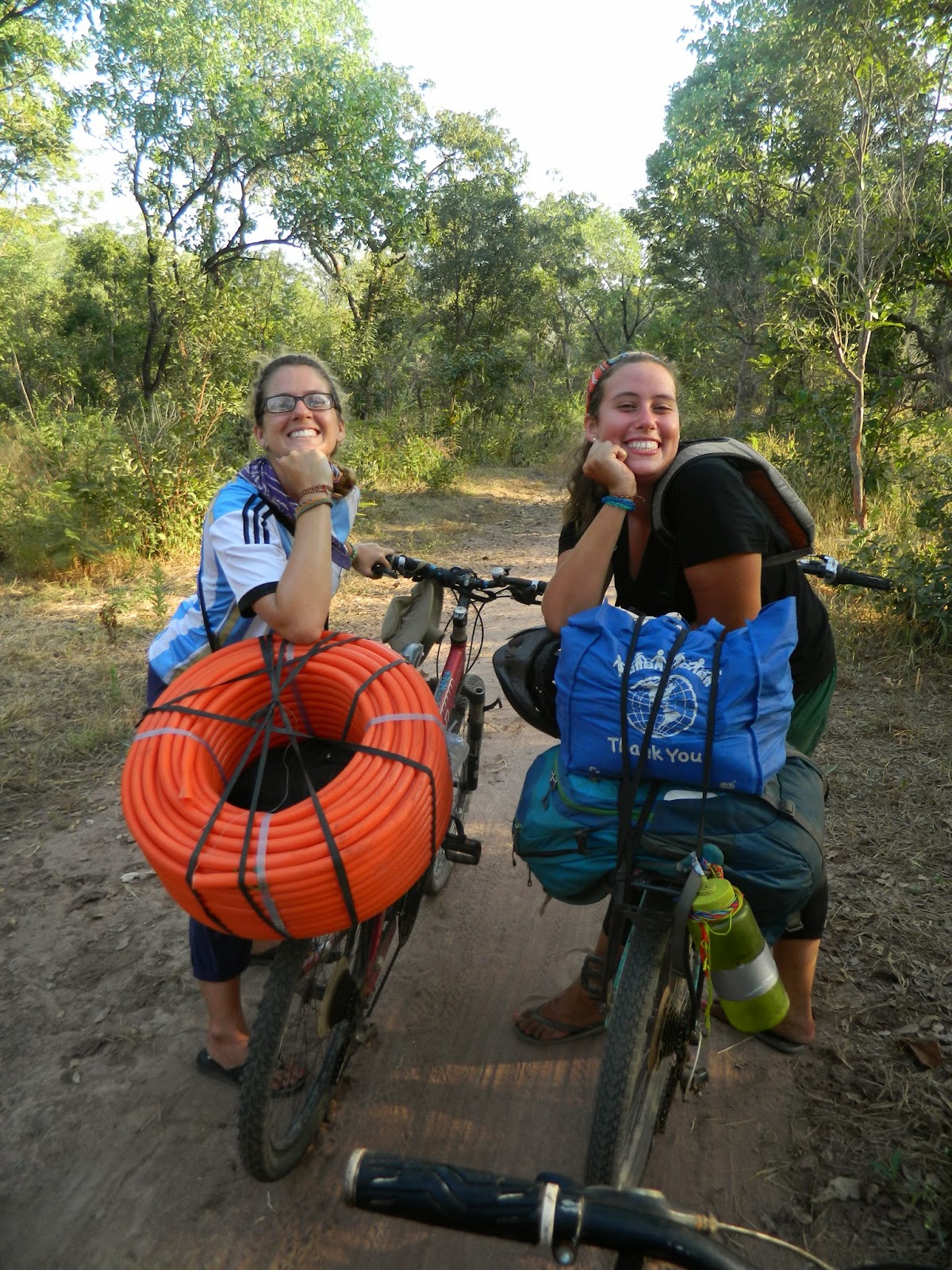 |
| What baggage? |
Scholarship 2014
Oh hello! Just recently remembered that I have a blog, but in my defense I've been very busy! Forgive me, but I'm going to go a little bit out of order and start with my scholarship girls because I love them the most.
So as my Facebook friends will know, I did the Michelle Sylvester Scholarship at my local middle school again this year. The goal of the scholarship is to keep at risk girls in school. "At-risk" includes risk from poverty, risk of early marriage, and risk of pregnancy. It also awards high achieving girls- all of my girls were at the top of their class.
You'll all remember my girls last year (pictured below). I had six of the smartest girls in the school in the program. This year, one went on to high school, one failed her finals but passed her BFEM (the test one needs to pass be allowed to go to high school), two are in 3eme this year (9th grade) and were awarded the scholarship again, and two got married and will not be continuing their education. In an effort not to turn this specific post into a rant about my feeling on teenage marriage, I'll just say I'll write about it later.
This year, though, we added three more girls to the list. Peace Corps (and by "Peace Corps" I of course mean my wonderful donors) paid for their inscription fees (about $10), bought them notebooks and pens, and the American Embassy in Dakar sweetened the deal by giving out free book bags literally full of everything a student is supposed to have and is almost always too poor to buy. This includes more notebooks, pens, pencils, protractor, ruler, mini chalk board, pencil case, and I'm forgetting everything else, but trust me, it's good. I told everyone it was from Obama, and were the mid-term elections in Sanankoro, I would now have total confidence in the Democrats sweeping it.
I had a much better time of it this year for several reasons. 1. I speak Pulaar this year. Last year I had to get the project started my first week at site, which was overwhelming, and I'm pretty sure not everyone understood everything, myself included. 2. I have a relationship with the school this year, and they trust me a lot more. 3. I have a relationship with the girls, and getting the scholarship is actually a really big deal now. 4. I had a much better outfit.
Let just conclude with a congratuatory note to Dienabou and Khady, who received the scholarship two years in a row, Mariama Sow, Fanta Seydi, Dienaba Kande, Mariama Balde, Assette Balde, Salle Mballo, and Asmou Seydi, CEM Sare Koutayel's scholarship girls and Senegal's future presidents, doctors, lawyers, and ministers. Not that I have high expectations or anything.
So as my Facebook friends will know, I did the Michelle Sylvester Scholarship at my local middle school again this year. The goal of the scholarship is to keep at risk girls in school. "At-risk" includes risk from poverty, risk of early marriage, and risk of pregnancy. It also awards high achieving girls- all of my girls were at the top of their class.
You'll all remember my girls last year (pictured below). I had six of the smartest girls in the school in the program. This year, one went on to high school, one failed her finals but passed her BFEM (the test one needs to pass be allowed to go to high school), two are in 3eme this year (9th grade) and were awarded the scholarship again, and two got married and will not be continuing their education. In an effort not to turn this specific post into a rant about my feeling on teenage marriage, I'll just say I'll write about it later.
 |
| MSS Scholarship Recipient 2013 |
 |
| Scholarship Recipients 2014 |
Let just conclude with a congratuatory note to Dienabou and Khady, who received the scholarship two years in a row, Mariama Sow, Fanta Seydi, Dienaba Kande, Mariama Balde, Assette Balde, Salle Mballo, and Asmou Seydi, CEM Sare Koutayel's scholarship girls and Senegal's future presidents, doctors, lawyers, and ministers. Not that I have high expectations or anything.
Subscribe to:
Posts (Atom)